Overview
The MBBS UniKL programme is a five (5) year programme conducted at UniKL RCMP campus in Ipoh, Perak. It is taught by full-time academic staff who bring with them years of experience in the field of medicine. They are complemented by senior clinicians and specialists from Hospital Raja Permaisuri Bainun, Ipoh and other hospitals in Perak who are equally enthusiastic in sharing their vast knowledge and experience with the students.
One distinctive aspect of the MBBS UniKL programme is its unique curriculum which is modelled on the University of Sheffield UK MBChB medical programme as well as the MBBS programme of Universiti Malaya.
UniKL RCMP uses the integrated teaching method in producing quality medical students who are able to deliver effective diagnosis for better treatment of patients. Students learn in the context of medical problems while integrating all related sciences with clinical learning as the basis.
Upon completion of the MBBS UniKL programme, graduates will be posted to government hospitals for their initial training as interns.
Programme Educational Objectives (PEOs)
-
PEO 1
To produce graduates who are knowledgeable, competent, and innovative who will contribute towards the human capital in medicine and other health sciences. -
PEO 2
To produce graduates who have effective leadership and teamwork skills as well as verbal, non-verbal and interpersonal communication skills to support their role in the health industry. -
PEO 3
To produce graduates who are committed to the importance of lifelong learning and continuous improvement. -
PEO 4
To produce graduates who practice professionalism with ethics and social responsibility. -
PEO 5
To produce graduates with an entrepreneurial mindset.
Programme Learning Outcomes (PLOs)
-
PLO 1
Demonstrate comprehension of the fundamental principles in medicine acquired from recent texts. -
PLO 2
Critically appraise and solve problems in medicine by using an evidence-based approach. -
PLO 3
Perform clinical skills competently to manage and maintain the health of the community. -
PLO 4
Apply teamwork and interpersonal skills which are appropriate to healthcare practices. -
PLO 5
Communicate effectively and convey information, ideas, problems and solutions to medical and non-medical communities. -
PLO 6
Utilise a broad range of information, media and technological applications to enhance the medical profession. -
PLO 7
Interpret numerical and graphical data to improve the standards of medical care. -
PLO 8
Perform duties autonomously, responsibly and demonstrate leadership within a team. -
PLO 9
Engage in self-directed lifelong learning and acquire an entrepreneurial mindset. -
PLO 10
Demonstrate ethical principles and professionalism in medical care.
Programme Structure
Year 1
- Foundation I
- Foundation II
- Haematology / Immunology / Genetics / Oncology (HIGO)
- Intensive Clinical Experience (ICE)
- Cardiovascular
- Respiratory
Year 2
- Gastrointestinal
- Musculoskeletal
- Genito-Urinary
- SSM Project (Introduction to Research)
- Endocrine & Reproductive
- Nervous System
Year 3
- Basic Clinical Course
- Public Health
- Medicine
- Surgery
- Paediatrics
- Obstetrics & Gynaecology (O&G)
- Orthopaedics
- Psychiatry
Year 4
- Medicine in the Community
- Psychiatry
- Specialty I – ENT (2) – Ophthalmology (2) – Dermatology (1) – Haematology (1) – Rheumatology (1)
- Specialty II – Accident & Emergency (2) – Anesthesiology (2) – Radiology (2) – Forensic & Community
- SSM Project (Advanced Research)
- Elective
Year 5
- Medicine – Cardiology – Neurology – Infectious Diseases
- Surgery (including Neuro & Plastic Surgery)
- Paediatrics
- Obstetrics & Gynaecology (O&G)
- Orthopaedics
- Primary Care
- Pre-Registration House Officer
Career Path
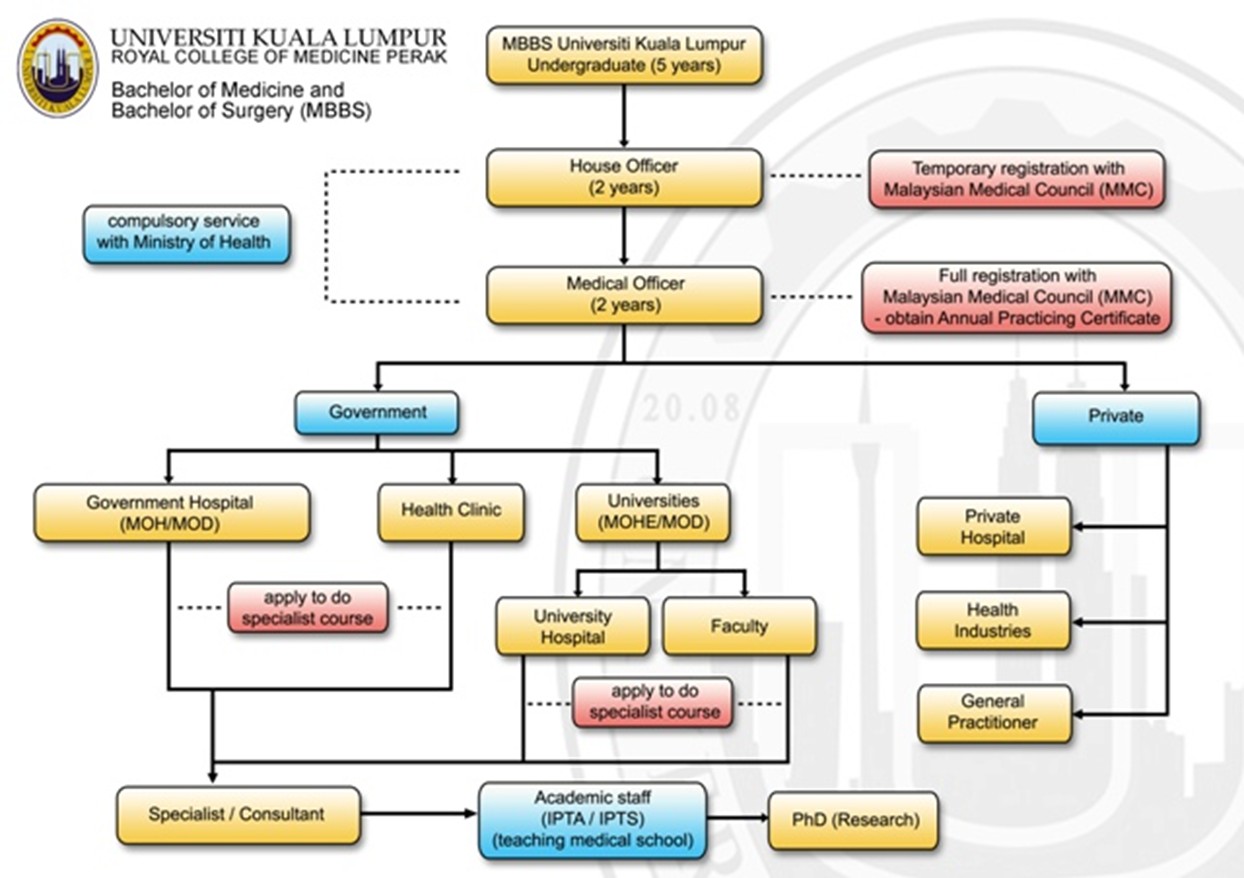
Entry Requirements
All applicants shall have attained a level of competence in English to enable them to complete the course successfully.
All applicants, who enter a matriculation, foundation or pre-medical programme, except those with a degree qualification in arts or humanities, shall have passed and attained a minimum of the following at School Certificate level or its equivalent:
Sijil Pelajaran Malaysia (SPM)
- Biology
- Chemistry
- Physics
- Mathematics or Additional Mathematics
- Another subject
5 Bs, each in the subjects above
General Certificate of Education (O Levels)
- Biology
- Chemistry
- Physics
- Mathematics or Additional Mathematics
- Another subject
5 Bs, each in the subjects above
Unified Examination Certificate (UEC)
All applicants with a UEC who enter a matriculation, foundation or pre-medical programme, except those with a degree qualification in arts or humanities, shall have passed and attained minimum of B4 each in 3 subjects i.e.:
- Biology
- Chemistry
- Physics or Mathematics or Additional Mathematics
All applicants shall have passed and attained a minimum of the following at:
- A. Higher School Certificate level or its equivalent:
- STPM: Grade BBB, ABC or AAA in 3 subjects i.e. Biology, Chemistry, Physics or Mathematics
- A LEVEL: Grade BBB, ABC or AAA in 3 subjects i.e. Biology, Chemistry, Physics or Mathematics
- MATRICULATION / FOUNDATION IN SCIENCE / PRE-MEDICAL COURSE: CGPA 3.0 (out of 4) in 3 subjects i.e. Biology, Chemistry, Physics or Mathematics AND provided that the course is not less than 1 year in the same accredited institution
- INTERNATIONAL BACCALAUREATE: Minimum overall score 33 points, 2 science subjects (Biology and Chemistry) at Higher Level (HL) AND Mathematics at HL AND attained a minimum score of 5 each in Biology; Chemistry; and Mathematics
- Unified Examination Certificate (UEC): B4 each in 5 subjects i.e. Biology, Chemistry, Physics, Advanced Mathematics I OR Mathematics; AND Advanced Mathematics II OR Advanced Mathematics
- SAM / MUFY / AUSMAT / UNSW FOUNDATION / HSC SYDNEY AUSTRALIA / TRINITY COLLEGE FOUNDATION / AUSTRALIA UNIVERSITIES FOUNDATION / WESTERN AUSTRALIA CURRICULUM COUNCIL / VICTORIAN CERTIFICATE OF EDUCATION / NCEA / NEW ZEALAND BURSARY / CPU / CIMP / ONTARIO SECONDARY SCHOOL DIPLOMA: Aggregate or the equivalent of B in 3 subjects Biology and Chemistry and Physics or Mathematics
OR
80% ATAR provided the subject include Biology and Chemistry and Physics or Mathematics - INDIAN PRE-UNIVERSITY:
Pass the NEET* Exam; and Average of 70% in 3 subjects i.e.
Biology; AND Chemistry; AND Physics OR Mathematics
*NEET – National Eligibility cum Entrance Test
**The NEET is REQUIRED for those who wish to work in India as medical practitioner.
*** For those who do not intend to work as a medical practitioner in India must provide a signed letter of undertaking witnessed by a Lawyer or Commissioner of Oath. This letter of undertaking must clearly state that they will not seek registration with the National Medical Commission of India.
DIPLOMA IN HEALTH SCIENCES:
- CGPA 3.50 (out of 4.0)
- Course duration not less than 5 semesters or 2½ years in the same accredited institution
- PASS in SPM or its equivalent with 2 Bs each in Biology, Chemistry, Physics or Mathematics and 3 credits each in English, Mathematics or Additional Mathematics and another subject
Degree Level:
- Degree in Health or Pure or Applied Sciences: CGPA 3.0 (out of 4.0) for 5-year medical programme OR CGPA 3.3 (out of 4.0) for 4-year graduate entry medical programme
- Degree in the Arts or Humanities: CGPA 3.5 (out of 4.0) for 5-year medical programme OR CGPA 3.75 (out of 4.0) for 4-year graduate entry medical programme
Notes:
- Applicants shall be required to undergo an aptitude test and/or an interview and/or a university entrance examination.
- Graduates from a medical programme who seek employment in the public sector must fulfil the criteria set by the Public Services Commission of Malaysia (SPA).
International Students
Click Here
Tuition Fee
Malaysian Students
RM 60,000.00 (Per Year)
RM 300,000.00 (Total Tuition Fee)
International Students
RM 88,400.00 (Per Year)
RM 442,000.00 (Total Tuition Fee)
* Fees shown are the tuition fees only
** Fees shown are not inclusive of visa processing fee (international students)
*** Fees and charges are subject to Malaysian Sales and Service Tax (SST) at the prevailing rate of 6%.
SST implementation.
**** Fees shown are correct at time of publication and subject to change without prior notice.