Overview
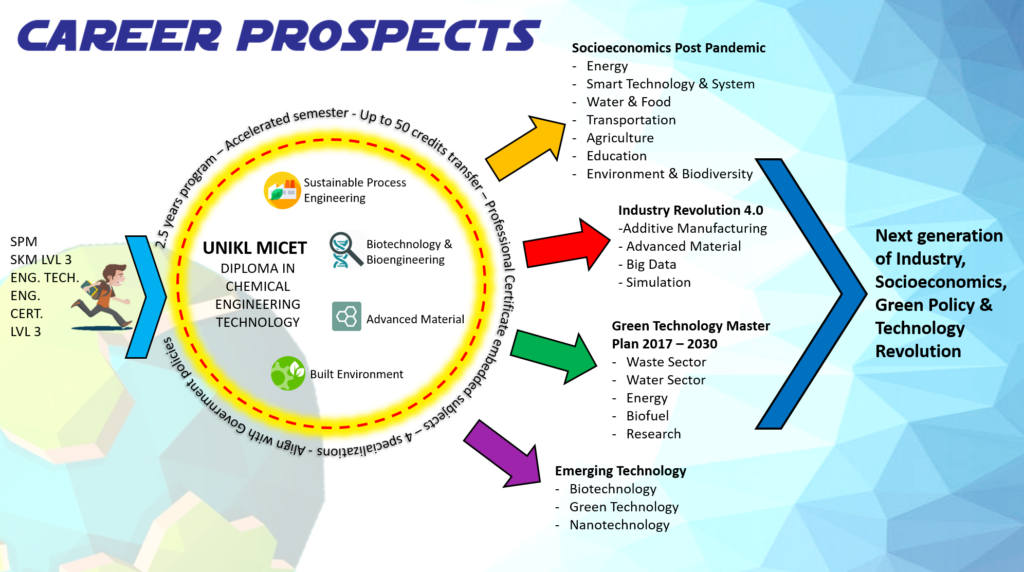
As Industrial Revolution 4.0 such as additive manufacturing, advanced material, big data, and advanced simulation continue to redefine industrial production, Malaysia’s chemical industry is increasingly searching for highly skilled manpower with Industry 4.0-ready skill sets to enhance its transformation. In order support this, UniKL MICET will begin offering a 2.5-year diploma programme in Chemical Engineering Technology (DCET) in July 2021. The curriculum is designed to produce manpower with the requisite skills for economic and national development of the nation. The four major specialisations in the program are Sustainable Process Engineering, Biotechnology & Bioengineering, Advanced Material, and Environmental Engineering Technology & Sustainability. This program’s courses are enhanced by embedding Professional Certifications including Smart 3D Modelling Software (Intergraph) and Ergonomic Trained Person. With credit transfer eligibility of up to 57 credits, graduates from this programme can continue and complete Bachelor of Chemical Engineering Technology at UniKL MICET in 2.5 years. This programme is also in line with the post pandemic socioeconomics drivers, which are focused on energy, smart technology and systems, water and food, environment, and biodiversity.Programme Educational Objectives (PEOs)
-
PEO1
Competent and forward-thinking in the field of chemical engineering technology, and capable of pursuing business and technopreneurial ventures -
PEO2
Effective leaders who demonstrate professionalism, ethics, social responsibility, and a commitment to sustainability, with good teamwork and communication skills. -
PEO3
Committed to lifelong learning, continuous improvement, and personal growth.
Programme Learning Outcomes (PLOs)
Majors in chemical engineering will be able to:-
PLO1
Engineering Knowledge:
Apply knowledge of applied mathematics, applied science, computing and engineering fundamentals and an engineering specialisation as specified in DK1 to DK4 respectively to wide practical procedures and practices. -
PLO2
Problem Analysis:
Identify and analyse well-defined engineering problems reaching substantiated conclusions using codified methods of analysis specific to their field of activity (DK1 to DK4) -
PLO3
Design/Development of Solution:
Design solutions for well- defined technical problems and assist with the design of systems, components or processes to meet specified needs with appropriate consideration for public health and safety, as well as cultural, societal, and environmental considerations as required (DK5). -
PLO4
Investigation:
Conduct investigations of well-defined problems; locate and search relevant codes and catalogues, conduct standard tests and measurements (DK8) -
PLO5
Tool Usage:
Apply appropriate techniques, resources, and modern engineering computing and IT tools to well-defined engineering problems, with an awareness of the limitations (DK2 and DK6). -
PLO6
The Engineering Technician and The World:
Consider sustainable development impacts to: society, the economy, sustainability, health and safety, legal frameworks, and the environment, in solving well-defined engineering problems (DK1, DK5, and DK7). -
PLO7
Ethics:
Understand and commit to professional ethics and responsibilities and norms of technician practice and including compliance with national and international laws. Demonstrate an understanding of the need for diversity and inclusion; (DK9). -
PLO8
Individual and Collaborative Team Work:
Function effectively as an individual, and as a member in diverse and inclusive teams in multi-disciplinary, face-to-face, remote and distributed settings; (DK9). -
PLO9
Communication:
Communicate effectively and inclusively on well-defined engineering activities with the engineering community and with society at large, by being able to comprehend the work of others, document their own work, and give and receive clear instructions. -
PLO10
Project Management and Finance:
Demonstrate awareness of engineering management principles as a member or leader in a technical team and to manage projects in multidisciplinary environments. -
PLO11
Life Long Learning:
Recognize the need for, and have the ability for i) independent and life-long learning and ii) critical thinking in the face of specialised technical knowledge; (DK8).
Programme Structure
Semester 1
- Religious Practices in Malaysia
- Co-curriculum
- Interpersonal Skills
- Competency English
- Introduction to Entrepreneurship
- Foreign Language 1
- General Chemistry
- Technical Mathematics 1
- Electrical Technology
Semester 2
- Pengajian Malaysia
- Communication English 1
- Technical Mathematics 2
- Organic & Analytical Chemistry
- Thermodynamics
- Fluid Mechanics
- Material & Energy Balance
Semester 3
- Communication English 2
- Foreign Language 2
- Heat Transfer
- Process Instrumentation & Control
- Mass Transfer
- Industrial Safety & Health
- Elective 1
- Elective 2
Semester 4
- Engineering Statistics
- Reaction Engineering
- Engineering Drawing
- Elective 3
- Elective 4
- Final Year Project (FYP)
Semester 5
- Industrial Training
Specialization: Sustainable Process Engineering
- Elective 1: Plant Utility & Safety
- Elective 2: Petrochemical & Petroleum Refining Technology
- Elective 3: Plant Maintenance & Inspection
- Elective 4: Oil & Fat Process Technology
Specialization: Biotechnology & Bioengineering
- Elective 1: Introduction to Bioprocess Technology
- Elective 2: Principle of Microbiology
- Elective 3: Analytical Methods in Bioprocessing
- Elective 4: Techniques in Bioproduct Recovery
Specialization: Advanced Material
- Elective 1: Rubber Processing
- Elective 2: Plastics Processing
- Elective 3: Latex Science & Technology
- Elective 4: Composite Technology
Specialization: Environment Engineering Technology and Sustainability
- Elective 1: Wastewater Treatment Technology
- Elective 2: Air Pollution Control Technology
- Elective 3: Introduction to Environmental Engineering Technology
- Elective 4: Solid and Hazardous Waste Management
Career Information
Job Prospects for Graduates of the Programme;
- Chemical Manufacturing Companies
- Petroleum and Petrochemical Industries
- Energy and Transportation Industries
- Oleochemical Industries
- Safety and Health
- Design and Simulation Industries
- Bioplastic Industries
- Rubber and Latex Industries
- Cosmeceutical Industries
- Nutraceuticals Industries
- Biopharmaceutical Companies and Medical Research Institutes
- Environmental Consulting Firms
- Solid Waste and Wastewater Management Sector
Career Path for Graduates of the Programme;
- Chemical Production Assistant Engineer
- Plating Technician
- Plant Assistant Engineer
- Plant 3D Software Trainer
- Laboratory Technician
- Chemical Production Assistant
- Chemical Sales & Service Technician
- Primary Production Executive
- Compounding Supervisor
- QA Executive
- Quality and Reliability Technician
- Materials Analysis Technician
- Wastewater Treatment Process Technician
(Source: Jobstreet, Careerjet)
Entry Requirements
Click Here Fee: Local Students:
International Students:
- Pass in SPM or its equivalent with at least credits (minimum Grade C and higher) in Mathematics and Natural Sciences or Technical Based Subjects; OR
- Pass in O-Level with minimum Grade C in three (3) subjects including Mathematics and science or technical based subjects; OR
- Accredited Certificate in Engineering, Engineering Technology, Technical or Malaysian Skills Certificate Level 3 with PT3; or its equivalent; OR
- Recognized related Technical/Vocational/Skills qualifications AND an adequate and relevant bridging programme; OR
- Pass Technical/Vocational/Skills qualifications and recognized and approve by UniKL Senate
- Pass in Sijil Vokasional Malaysia (SVM) qualification been recognized by government of Malaysia and according to approval by UniKL Senate.
-
SVM is recognized as equivalent to 3 credits SPM for candidates who obtain:
- Academic CGPA is equal to or greater than 2.00;
- Vocational CGPA is equal to or greater than 2.67 and competent in all vocational modules;
- Credit in Bahasa Melayu with SVM Code 1104;
- Pass in Sejarah for graduate cohort 2013-2016
Click Here Fee: Local Students:
RM 6,840.00 (Per Semester)
RM 13,680.00 (Per Year)
RM 34,200.00 (Total Tuition Fee)
International Students:
RM 7,450.00 (Per Semester)
RM (Total Tuition Fee)
* Fees shown are the tuition fees only.
** Fees shown are not inclusive of visa processing fee (international students).
*** Fees and charges are subject to Malaysian Sales and Service Tax (SST) at the prevailing rate of 6%.
SST implementation
.
**** Fees shown are correct at time of publication and subject to change without prior notice.